

Florida motorcycle helmet law at a glance
Florida Statutes section 316.211 generally requires a person operating or riding a motorcycle to wear protective headgear that complies with the standards identified in the statute.
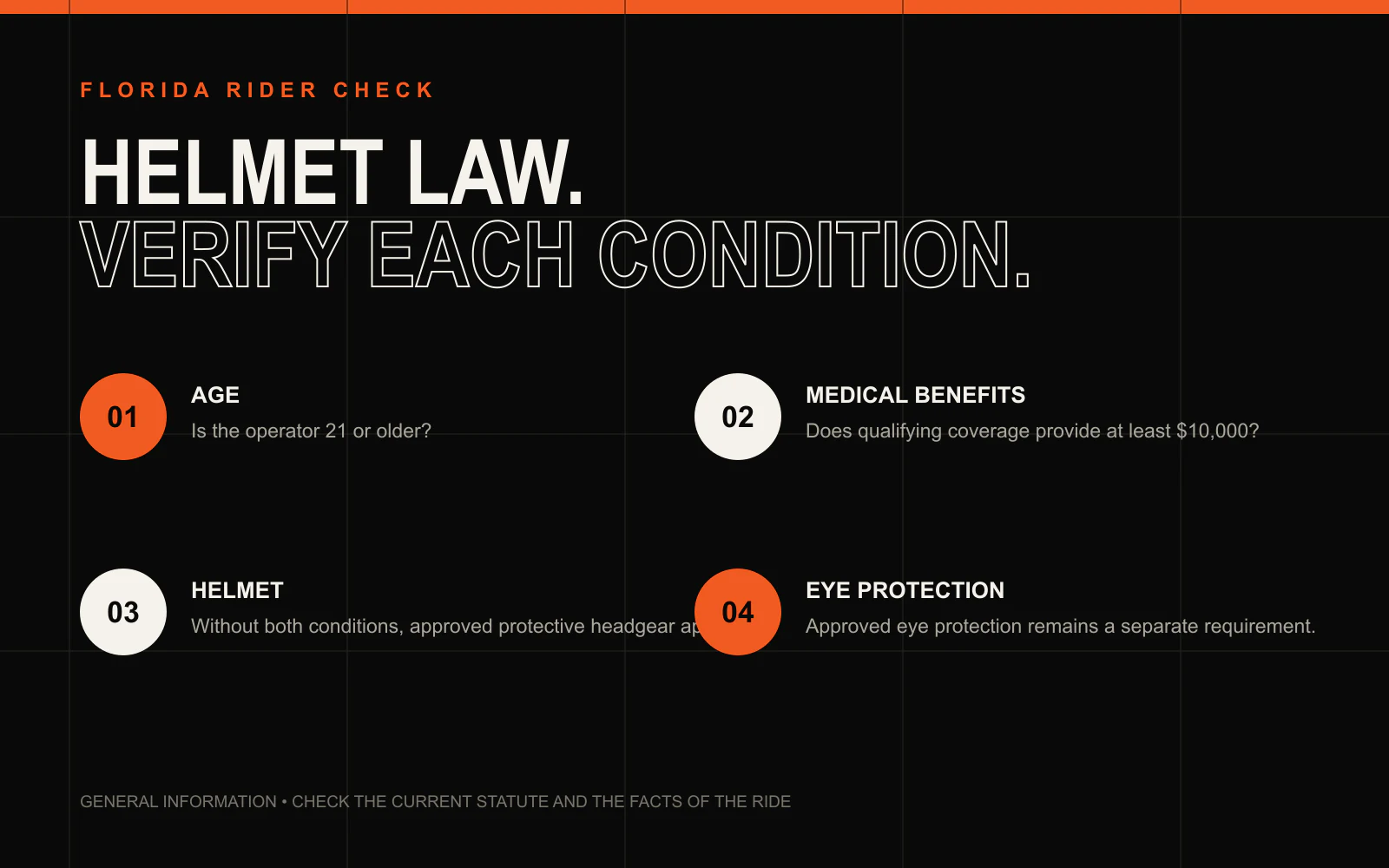
The statute contains a limited exception for a person over 21 who is covered by an insurance policy providing at least $10,000 in medical benefits for injuries incurred in a motorcycle crash. Both the age and coverage conditions require proof.
The over-21 medical-benefit exception
Turning 21 does not, by itself, complete the exception. The operator or passenger must also have the qualifying medical-benefit coverage described by the current statute.
Keep the policy, declarations page, endorsement, benefit description, effective dates, and proof of who was covered. A card or general statement about having insurance may not answer the specific medical-benefit question.
Was the person over 21 on the date of the ride?
Was a qualifying policy in force on that date?
Did it provide at least $10,000 in the medical benefits described by the statute?
Did the coverage apply to the operator or passenger whose helmet use is being reviewed?
Eye protection is a separate Florida requirement
Florida separately requires eye-protective devices of a type approved by the department. The helmet exception does not erase that eye-protection requirement.
Document the visor, goggles, windshield, or other equipment actually in use, and preserve it when its condition may matter after a crash.
Operators and passengers require separate facts
The statute addresses both operating and riding upon a motorcycle. Record each person's age, helmet, eye protection, seating position, and coverage instead of assuming the operator's circumstances automatically answer the passenger's question.
Photographs, the physical gear, policy records, medical records, and witness accounts can help establish what was in use and who was covered.
Helmet use does not automatically decide crash responsibility
A helmet question is different from the question of who caused a collision. Responsibility for the crash may depend on traffic movement, right of way, visibility, speed, roadway conditions, distraction, witnesses, and other evidence.
Whether helmet use affected a particular injury is also a fact-specific medical and legal question. Avoid turning a general safety rule into an unsupported conclusion about every injury or loss.
Records to preserve after a Florida motorcycle crash
Preserve the helmet, visor, goggles, jacket, gloves, boots, motorcycle, photographs, report, witness information, license and endorsement records, insurance documents, and medical records in their original condition when practical.
If an insurer or another party raises the helmet exception, ask which age, policy, benefit, equipment, or injury fact supports the position and keep that explanation in writing.
Common questions about Florida motorcycle helmet law
Can a rider over 21 always ride without a helmet in Florida?
No. The current statute also requires the medical-benefit coverage described in the exception. Age alone is not enough.
Does the helmet exception remove the eye-protection rule?
No. Eye protection is addressed separately in section 316.211 and should be checked independently.
Does riding without a helmet prove the rider caused the crash?
No. Crash responsibility and helmet use are different questions. The conduct of every road user and the connection between any rule and a claimed injury require separate analysis.
What proof may show the medical-benefit condition?
Relevant proof may include the policy, declarations page, endorsements, benefit descriptions, effective dates, and confirmation of who was covered on the date of the ride.