

Michigan motorcycle helmet law at a glance
Michigan requires an approved crash helmet unless every condition for a limited exception is satisfied. The operator and passenger rules are not identical, so each person requires a separate factual check.
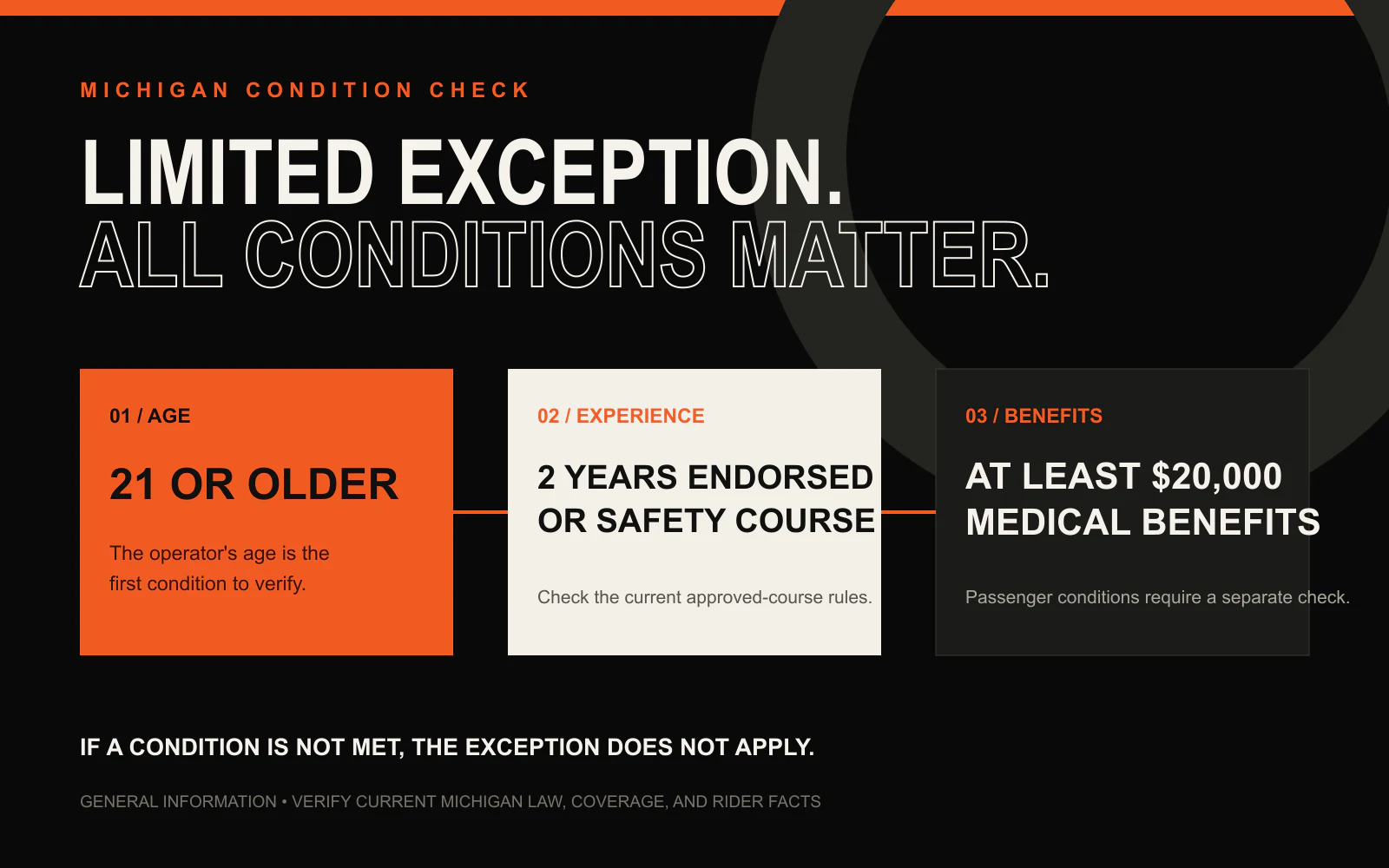
For an operator, official Michigan guidance identifies age, endorsement or approved-course history, and first-party medical benefits as connected conditions. Missing one condition means the exception does not apply.
The operator's three connected conditions
The operator must be at least 21 and have held a motorcycle endorsement for at least two years or completed an approved motorcycle-safety course. Section 257.658 also requires the applicable first-party medical-benefit security: the formulation changes depending on whether the operator rides alone, carries a passenger, or the passenger holds separate qualifying security.
Verify the endorsement issue date or course record, operator-passenger configuration, policy, benefit amount, covered person, and effective dates. A general insurance card or memory of completing a course may not establish every condition.
Age 21 or older
Motorcycle endorsement held for at least two years or an approved safety course completed
Applicable first-party medical-benefit security under section 257.658(5)(c)
Passenger conditions require a separate review
A passenger must be at least 21. Section 257.658 then links the helmet exception to the applicable first-party medical-benefit security held by the passenger or the operator and includes a separate operator-with-passenger formulation.
Do not reduce that rule to a passenger-only policy or assume the operator's general eligibility answers every passenger question. Identify the operator-passenger configuration, each person's age, who held the security, the benefit amount, the covered person, and the effective dates.
Helmet condition, approval, and preservation
When a helmet was worn, preserve the actual helmet and document its labels, condition, visor, impact marks, retention system, and storage after the crash. Do not clean, repair, or discard it when its condition may matter.
Photographs and witness accounts can supplement the physical item, but they do not always show fit, damage, approval labels, or whether the strap was secured.
Helmet use is different from crash responsibility
The helmet question does not determine who caused the collision. Lane position, right of way, vehicle movement, visibility, speed, distraction, signals, roadway conditions, and other evidence remain separate.
Whether a helmet issue affected a claimed injury is also a fact-specific medical and legal question. Avoid unsupported assumptions about injuries that a particular helmet would or would not have changed.
Common questions about Michigan motorcycle helmet law
Is being 21 enough to ride without a helmet in Michigan?
No. An operator must also satisfy the endorsement or approved-course condition and the first-party medical-benefit condition described by current Michigan guidance.
Does the passenger use the operator's eligibility?
Not as a blanket carry-over. Section 257.658 uses operator-or-passenger medical-benefit alternatives and an operator-with-passenger formulation. Verify the configuration, who held the security, the amount, the covered person, and the coverage date.
What records may prove the exception?
Relevant records may include identification, endorsement history, approved-course completion, the full policy, declarations and endorsements, benefit descriptions, and effective dates.
Does a helmet violation prove the rider caused the crash?
No. Crash responsibility depends on the conduct that caused the collision and the supporting evidence. Any relationship between helmet use and a particular injury requires a separate analysis.