
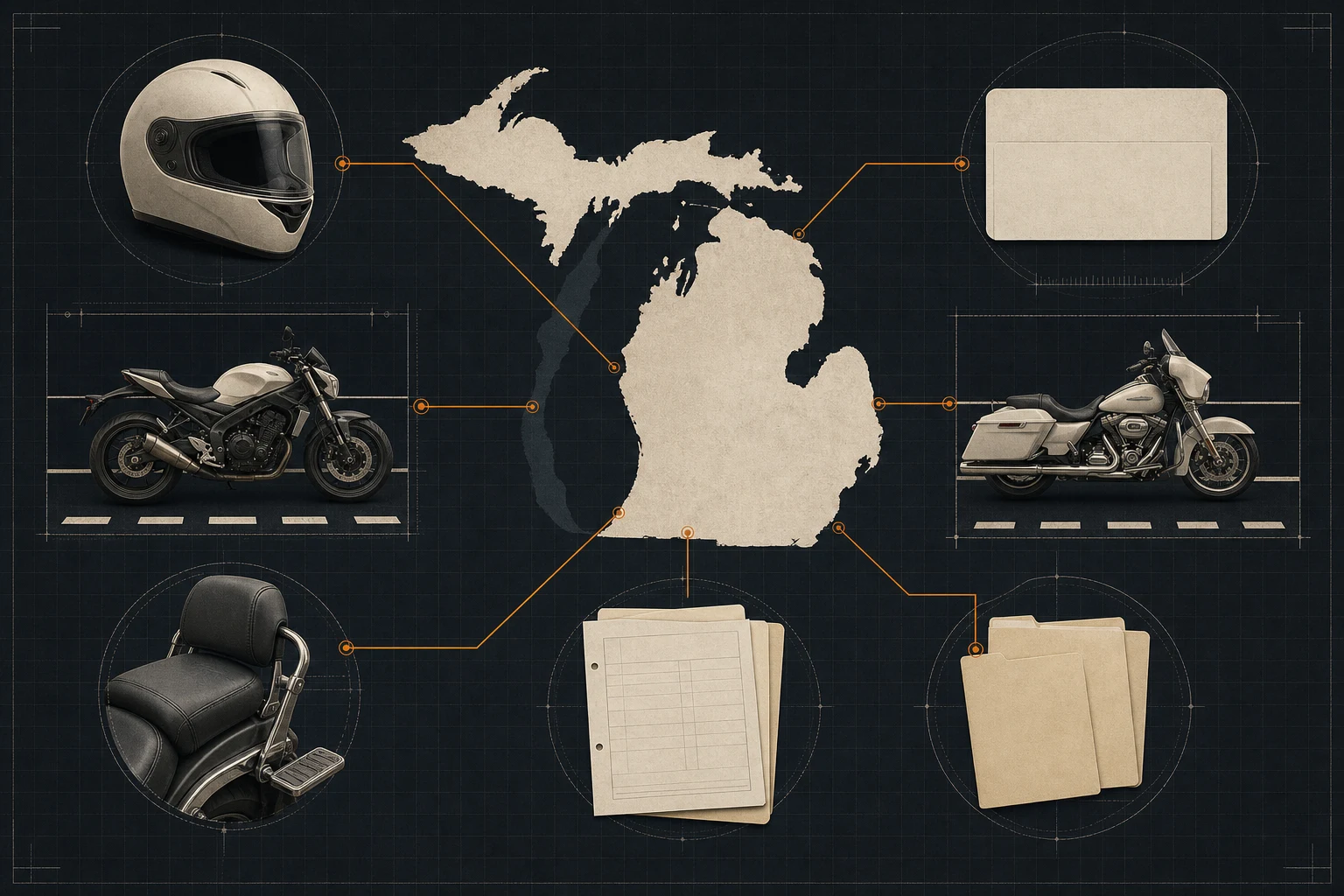
Michigan uses separate statutes for endorsement, equipment, and lane use
Michigan's motorcycle rules are distributed across the Vehicle Code. Section 257.312a addresses the motorcycle indorsement, sections 257.658 and 257.658a address seating, passengers, and helmets, and section 257.660 addresses lane use.
This guide is general information, not a substitute for legal review. The current statute and the law in effect on the ride date should be checked before a conclusion is applied to a crash.
A Michigan motorcycle indorsement is a separate authorization
Michigan Compiled Laws section 257.312a states that, before operating a motorcycle other than an autocycle on a public street or highway, an individual must obtain a motorcycle indorsement on the operator's or chauffeur's license.
Use the license and state record to verify the indorsement and its effective date. Training history may matter to the helmet exception discussed below, but neither an indorsement nor a course certificate decides the separate question of how a collision occurred.
The over-21 helmet exception has multiple conditions
Section 257.658 begins with a general helmet requirement for a person operating or riding on a motorcycle. Subsection (5) sets different conditions for a person age 21 or older: an operator must satisfy the endorsement-duration or motorcycle-safety-course condition and the applicable first-party medical-benefit security condition stated in subsection (5)(c).
For a passenger age 21 or older, the statute ties the exception to the passenger or operator satisfying the applicable medical-benefit security condition. The subsection states amounts and a different operator-with-passenger formulation, so verify the operator, passenger, endorsement or course, and coverage records separately instead of using an age-only rule.
Seats, capacity, and passenger foot placement
Section 257.658 requires the operator to ride on the permanent regular seat and prohibits carrying more people than the motorcycle is designed and equipped to carry. Section 257.658a additionally requires adequate, securely attached seats and footrests or pegs for each designated seating position.
Under section 257.658a, a passenger generally may not ride unless the passenger's feet can rest on the assigned footrests or pegs; the statute states an exception for a person unable to reach them because of a permanent physical disability. Preserve photographs and specifications before repair or disposal changes the motorcycle.
Michigan protects full-lane use and restricts passing between traffic lines
Section 257.660 states that a motorcycle is entitled to full use of a lane and recognizes two motorcycles riding abreast. It prohibits riding more than two abreast and prohibits a motorcycle from passing between lines of traffic, while separately describing passing in an unoccupied lane on one-way and two-way streets.
The difference between an occupied lane, an unoccupied lane, and a movement between lines of traffic is factual. Preserve lane markings, traffic direction, each vehicle's position, photographs, video, witness information, and any available electronic data.
Records that resolve Michigan's statutory conditions
A reliable review connects each statutory element to a dated record. For helmet questions, that can require proof of age, the indorsement issue date or safety-course completion, the operator-passenger configuration, and the actual first-party medical-benefit security in effect on the ride date.
For passenger and lane-use questions, preserve the motorcycle's designed seating capacity, seats and pegs, road geometry, lane occupancy, and the sequence of movement. Keep every potentially connected motorcycle and automobile policy because broader coverage questions are distinct from the helmet exception.
Michigan motorcycle-law evidence checklist
Do not reduce a multi-part statutory condition to one fact such as age or possession of a license.
License, motorcycle indorsement, issue date, and course certificate
Operator and passenger ages and riding positions
First-party medical-benefit security in effect on the ride date
Designed seating capacity, seats, footrests or pegs, and photographs
Lane occupancy, road layout, traffic direction, video, and witnesses
Motorcycle and automobile policies, endorsements, and claim records
Common questions about Michigan motorcycle laws
Is being 21 enough to ride without a helmet in Michigan?
No. Section 257.658 states additional conditions, and the operator and passenger provisions are not identical. Verify every applicable condition from current records.
Does Michigan allow a motorcycle to pass between traffic lines?
Section 257.660 prohibits passing between lines of traffic. It separately addresses passing in an unoccupied lane, so the lane occupancy and street configuration matter.
Does an indorsement issue prove who caused the crash?
No. Authorization to operate and collision responsibility are different questions. Preserve the licensing record, then separately evaluate the movements, rules, roadway, witnesses, and physical evidence.